Tuesday, 29 November 2011

Finished Medieval Eating Knife

Click on the photos to get a bigger view


Sod it! On this occasion I am going to have to concede that someone else is right. It looks that Tod's claim that 'Anyone can do anything' certainly applies to making a knife. With only a minimal amount of basic tools I have assembled the knife, made the sheath and decorated it. And I have to say I am extremely pleased with the result.

The above image is of the back of the sheath, showing the tight seam running down the back. you can also see the grain in the handle. I am particularly pleased with the choice of Lacewood for the handle. I had to research Lacewood on the net before making my choice and I thought it looked quite unusual. It is a very delicate looking wood with a very pleasing pattern in the grain. By carefully selecting the best part of the scales provided for the handle I have managed to get a pretty handle, which I hope the photos here do justice to. It's even better in your hand.

The front of the sheath showing the tooling, a repeating pattern of diagonal lines and crosses made up of five rectangles. The tooling adds a nice touch and helps to make the sheath unique. The sheath has been dyed with red leather dye, some pretty evil stuff, but worth using. This photo shows the handle clearly with the brass bolster and the two brass rivets through the handle. The brass bolster is held in place by a brass rivet which is filed down to the point where it is almost invisible. The circular mark on the blade is Tod's mark.

The finished knife in the sheath. It is a tight fit, which is good news as I would be gutted if it drops out and I lose it.

So with only the use of some files, a vice, sandpaper, a hacksaw, coping saw, hammer and the kit supplied by Tod I have managed to construct my own eating knife. This is not a way of saving money; it is only three or four pounds more to get one made by Tod, but it is deeply satisfying to do and I will be very pleased to wear this next season. Thanks Tod.

BTW if I wouldn't say no to winning the big prize:0)

Monday, 21 November 2011

Knife Progress


OK so it wasn't quite done in a weekend, but here are some photos of the progress made on the knife project. I am rather chuffed with the results so far.


Knife with wooden scales cut rough shape and brass bolsters rough shaped too.


Two shots of the handle in different light. The handle is made from Lacewood, which has a pretty and subtle pattern to it, which is proving hard to photograph well. This is the handle mostly finished with the brass rivets in.


Knife and sheath. The sheath is double layered, and needs to be as the blade is ferociously sharp. It just awaits dying now. So project nearly complete, and as I said I am really pleased how this has gone so far. If I don't win Tod's main prize I won't mind too much as I will have a really nice knife that I made myself. However, Tod if you are reading this...

Saturday, 19 November 2011

A weekend project

A little packet arrived for my last week, special delivery. The contents are below.


Some of you will know what they are looking at and others will be wondering what the hell is that lot? Well it's pretty straightforward really. It is a kit for making a medieval eating knife from Tod of Tod's Stuff and The English Cutler www.todsstuff.co.uk . I won a the first round of a competition and this was the prize. Now the deal is, assemble the knife and sheath, and send Tod photos of the completed project to win this...

Belt, turned bollock pouch and a Burgundian Rondel (that's the knife) and jolly sharp too. I am going to take photos as i make it. I have never done anything like this before so we shall see how it turns out. Tod's axiom is that with a bit of application anyone can do anything. Let's see if he is right. Right I am off to the garage to get working.

Cheers for now:0)

Sunday, 13 November 2011

Piratical Progress - 1st building

Right then, first model finished. This is the one I started last month and I am rather pleased with it:0) This is the front elevation with balcony for extra swashbuckling action.


This has turned out quite well, and a lot like the sketches, see last Piratical Progress entry. The roofs on this model are cardboard slates. Many of the other buildings will be pantiles but I like this style.

Back yard with stairs from 1st floor. Two gates in the yard to encourage players to go through one side to the other.

Side elevation. One long wall with gate to backyard. Creeper on wall is from the GW plastic trees. the foliage on the trees looks pants but on flat walls it really works. It breaks up the white wall well and adds a splash of colour.


Other side elevation with front of smithy and doors to house visible. You can clearly see the horizontal lines which show where the model comes apart for access for models going indoors.


A peglegged fellow leaves by the back door.

The whole building in its constituent parts. Just like all my buildings for skirmishing this comes apart so those swabie dogs can get inside.

So there you go. A rather pleasing first effort at a 40mm building for my piratatical games, plenty more to come. But probably won't be featuring at a show next year as it I may well be officiating at a friend's wedding on the day of Salute2012. So I might have more time to produce stuff before it all makes a public appearance.

Wednesday, 2 November 2011

Battle on Ryde Esplanade


Second game of the week was a larger affair. Played between myself, Edward and El Hoggo. With the Princess Beatrice Rifles, The Peoples' Socialist Republic of the Isle Of Wight, and the Anglican League, repectively. This was played on a 6x4 foot board using plenty of scenery. The following is the report from my commanding officer to his CO. There may be other reports from the other factions to follow. Send them in chaps:0)

Sir

On receiving orders from Colonel Templeton Smyth to investigate the presence of Communist agitators in Ryde, I ordered my senior NCOs to have the men assemble on the parade ground. The whole platoon mounted up in the vehicles available and we headed immediately to Ryde. We were joined by a section of riflemen from the Royal Yacht Squadron who were also mounted in a truck.

Number one section led by Sergeant Hoskins was sent into the town first to scout the situation. Hoskins quickly met a local Police Constable who was able to report that Agitators had been present in the town for a number of days and many of the local working men and women had declared Ryde as the capital of the Peoples’ Socialist Republic of the Isle Of Wight. The constable went on to explain that the Communists had thrown up barricades around the Western end of the Esplanade and had made their headquarters on the pier.


Hoskins immediately returned to the column and we proceeded to the Eastern end of the Esplanade. My column of vehicles made its way on to the Esplanade from Seaview Road. It became immediately apparent that the Reds had indeed erected barricades to create a stronghold.


The Platoon advanced onto the Esplanade and immediately came under fire from the barricades. I believe the Reds had mounted a Pom Pom on the back of a truck to give them extra support. Number one section disembarked from their armoured truck which then headed towards the Reds to give covering fire with its Vickers.


Number Two section led by Sergeant Elphinstone also disembarked his men. Both sections came under fire, both rifle and machine gun, from a Seamen’s mission on the seawall. Both sections took casualties but were able to suppress the fire from the mission and its environs. The RYS troops took up position a little to the west of One and Two sections and engaged in a rifle battle with what appeared to be Naval troops behind a dry stone wall which surrounds Esplanade park.


The Reds’ Pom Pom was causing a great deal of concern as was the threat of Heavy Machine Gun fire from the Mission. Number One section’s Armoured truck and Number two sections Bulldog were able to little else than head towards the barricades. Number Two section’s Bulldog was crippled by machine gun fire and slid to a halt blocking much fire from the Socialists.


Corporal Sedgwick’s number three section disembarked closest to the barricades and were the only section to engage in hand to hand combat with the enemy. His men moved forward and engaged a unit of Reds which had come over the barricade. Sedgwick’s men went forwards with bayonets. At first they had some success, killing a man with a Lewis, however they were driven back when they came under attack by socialists hurling petrol bombs. The socialists lost heart and retired behind the barricades.


Sergeant Butcher’s Four section made good progress. They were first able to support One and Two sections with fire on the Mission. With concentrated fire they were able to drive off the sailors in the mission, except for a curious looking armoured vehicle. It appeared slow and cumbersome. It was as if a fellow had managed to mount a pillbox on wheels.

Butcher then took his men forward towards the Red barricades. It was Butcher’s men who disabled an enemy machine gun and the sailors behind the dry stone wall. Butcher then survived the last rounds fired by the enemy pom pom which then took no further part in the action.


My Platoon had taken several casualties, mostly in One and Two sections and the RYS men. We had two vehicles damaged and my Vickers team had all been wounded. We halted our advance to regroup, at this point it was apparent that the Socialists had withdrawn from their first line of barricades. The Red machine gunner wounded by Sedgwick’s men was taken prisoner. He informed us that the Reds would have only retired to a second line of barricades. It also appears that the militia attacking us from the Sailor's Misson were from the Anglican League not the Socialist's commune. I decided that a continued assault would require a greater force than I had at my disposal. I then followed orders given over the telephone to return to barracks in Carisbrooke.

It is hard to tell how many enemy casualties were inflicted, my estimate is somewhere between thirty or forty. Privates Wilson, Smith G, Smith R and Davies were killed. As were three men from the RYS. We also had three other men badly wounded and a dozen men with light wounds.

Lt T WCooper Commanding

3rd Platoon, 1st Company, 1st Battalion Princess Beatrice Rifles

Monday, 31 October 2011

Two games in one week!


Blimey, something that is almost unheard of occurred here last week. I managed to get two, yes two, games of VBCW in during the same week. I love Half Term holidays me. The first one is here the second is to follow.

Tuesday evening Ant and Francis came round to try some different rules sets for VBCW. Firstly WH Historical's Great War then England's Pleasant Pastures from a friends club. We played the same scenario through twice, once with each set. Both rules sets have their own merits:
Great War is essentially WH40k in another time and place, it works pretty well. But I don't really like the my turn your turn aspect of the game. EPP works on a playing card initiative system that works well, but can clutter up the table with cards. Neither set of rules really did it as both are written for larger games than this. But with some tweaking I think EPP will see more use.

Anyway to the game...

Our campaign is set on the Isle of Wight and this skirmish was fought near Shalfleet.
As you can see the board was four and half feet by three. It featured a small church by the main Freshwater to Newport railway line. Francis' Vectis Nationalists patrol had been chased out of Shalfleet by the Wight Constabulary which was being supported by or egged on by a BUF patrol. The Nationalists took refuge in the church and decided to sell themselves dearly.

The Nationalists had limited weaponry mostly rifles with a couple of Lewis machine guns. They took up position, mostly along the dry stone wall that surrounded the church yard, some were on the top of the church tower and some within the church. The Nationalist aimed to keep alive for six turns to see if reinforcements would arrive.
The BUF and police were equipped with rifles, a couple of Lewis', the odd SMG. They also had a Lancia armoured truck and another truck as well. The Lancia has a mounted Lewis machine gun. The first game using Great War rules was pretty pacey. Francis had the upper hand first inflicting casualties from his relatively strong position behind the stone wall. But the BUF made its numbers tell and in a brief time they had overwhelmed the defenders. They got into the church yard in force and riddled the church with bullets. In the fifth turn the three remaining Nationalist laid down their weapons and surrendered.

The game had gone pretty well and we decided we had enough time to do it again so we reset and went again with EPP. These rules are patchy as they are still in development. BUt we did like the card based initiative system, it makes you think very carefully about what you turn will look like. On the downside, these rules are made for bigger games and quick play, which means there is only two rolls when shooting; To Hit and save. No rolling to wound seemed quite odd and very deadly. OK if you are playing games with 50+ troops but quite demoralising if you only start with 12 or so. We did also make some errors with some rules especially rules for Spotting hidden troops, but those issues have since been resolved.

The second game also was won by the BUF but it was a close run thing, with the fascists taking far more casualties including a whole five man squad killed by one Molatov cocktail (The rules for which have been tweaked since by the rules' writers)


Overall I am really starting to enjoy VBCW. It looks great on the tabletop. Our scenery looks ace and with the addition of phone boxes, letter boxes and motor vehicles we really can capture the 'period'. The second game from last week is coming later. The most important thing that I learnt from this game was don't bother taking pics of toy soldiers without a tripod. Hence why I only have four useable photos from this game. Lots more for the Battle of Ryde Esplanade next.


Sunday, 23 October 2011

Piratical Progress

As previously stated this winter will see two projects and blimey if they both appear, at the moment, to be ticking over nicely. One game of VBCW (Very British Civil War) played, two more to come this week. Figures being painted like a fury. (VBCW post to follow) After one game of VBCW I had a wobble and my SALUTE2012 plans were nearly derailed as all of a sudden I fancied taking VBCW to SALUTE, and in some ways I am still tempted to, afterall 99% of the scenery is made and there are several of us painting toys for it. However I just can't help thinking that there might be several VBCW games at a show like SALUTE as it is a game very in vogue right now. So I think I am going to go with the more ambitious plan of 40mm pirates for SALUTE.

Yes that means all new figures and terrain but I love a challenge and the modeling side of the hobby is so important to me. I want to take new and fresh models to SALUTE, so that's what I am gonna do:0)

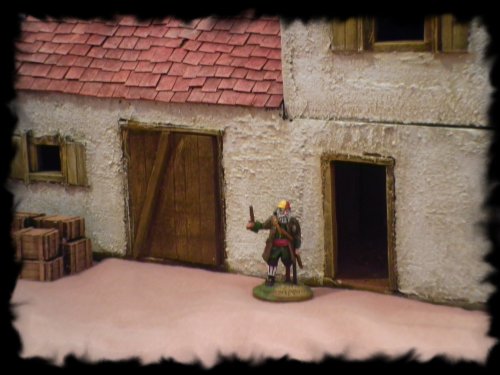
The first model for my new Pirate town is well under way. It is a smithy with an attached house. I doodled some concept sketches for this one (probably during a staff meeting) and the actual model is turning out pretty close to the sketches, with only the odd thing like location of chimneys and doors being any different.

As usual I am using foam board and balsa wood for the main structure on a hardboard base. The roof of this model will have cardboard shingles/slates, many of the other buildings will have pantiles.


I am having a lot of fun with this model, a new scale is always a welcome change and I am looking forward to the finishing process and the details that I can add. I have several other sketches that I will post including a map of the whole port which will show the scale of the project. Hope I am not biting off more than I can chew. But then it won't be the first time I have done that. Heyho! More progress updates soon.